


Small Woods And Hedgerows
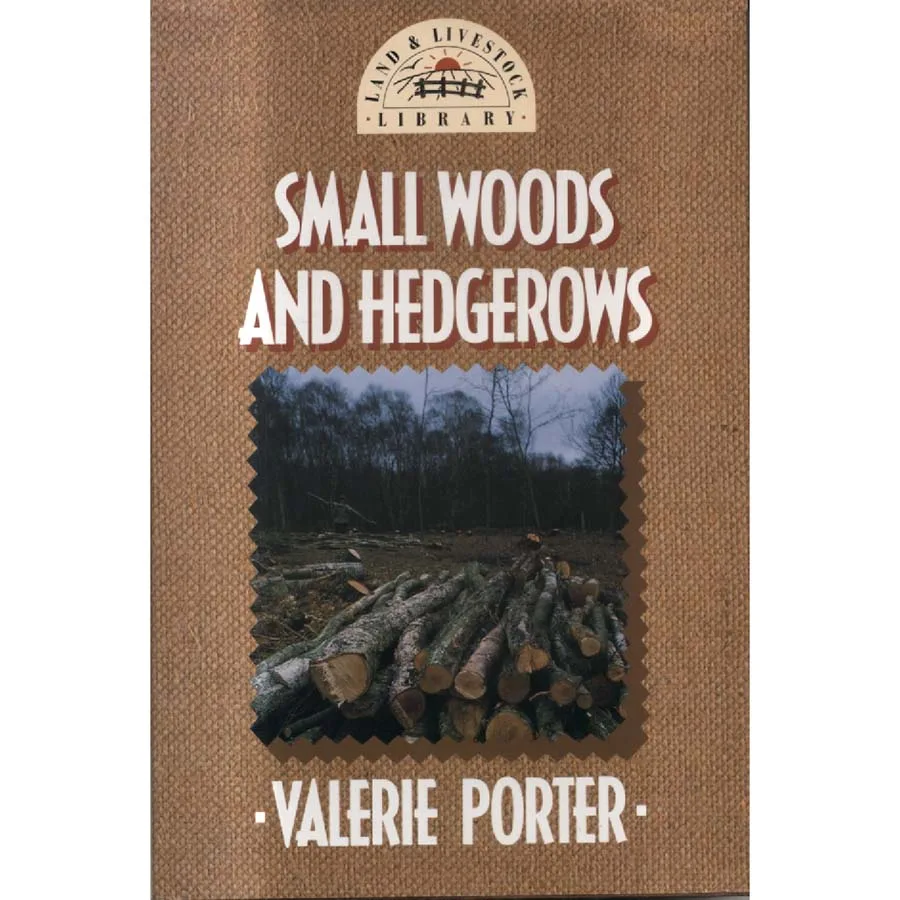
Publisher: Pelham Books
Format: Hardback
ISBN: 9780720718683
Small Woods and Hedgerows (1990) – Valerie Porter
Publisher: Pelham Books
ISBN: 9780720718683
Condition: Very Good
Sold by: Crappy Old Books
A Celebration of Trees, Hedges, Wildlife and the Peculiar British Tradition of Cutting Everything Back
There was once a time when the British countryside was a patchwork of small woods, ancient hedgerows, winding lanes, overgrown banks and mysterious little copses where generations of birds, insects, mammals and occasionally mildly suspicious-looking men in flat caps went about their business undisturbed. These were places of extraordinary ecological richness, shaped by centuries of farming, woodland management and the simple fact that nobody had yet invented a machine capable of removing three miles of hedgerow before lunchtime.
Then came agricultural modernisation, larger machinery, field consolidation and the persuasive economic argument that a hedge was essentially an inconvenient collection of bushes occupying perfectly good agricultural land.
Fortunately, not everybody agreed.
In Small Woods and Hedgerows, Valerie Porter turns her attention to two of the most familiar, valuable and frequently overlooked features of the British landscape. Published by Pelham Books in 1990, this is a book for anyone who has ever looked at a tangle of hawthorn, blackthorn, oak, ash, hazel and assorted vegetation and seen something considerably more interesting than an obstruction to efficient mowing.
It is about the countryside at its most intimate: the little patches of woodland, the living boundaries between fields, the networks of shelter and greenery that quietly support wildlife while asking very little in return, except perhaps that somebody refrain from bulldozing them.
Small Woods: Because Not Every Forest Needs to Be Enormous
When people think about woodland, they often imagine vast forests stretching towards the horizon, inhabited by deer, owls and possibly Robin Hood. Yet some of the most interesting wooded habitats are comparatively small, tucked between fields, behind farm buildings or alongside ancient tracks.
A little wood may contain only a modest collection of trees, but its ecological importance can be disproportionately large.
Trees provide nesting places, shelter, shade and food. Their roots influence soil and drainage, fallen leaves contribute to the woodland floor, and decaying timber supports an astonishing variety of fungi and invertebrates. Beneath the canopy, plants compete for light while generations of small creatures conduct their affairs with considerably less paperwork than their human neighbours.
Porter’s subject offers a reminder that woodland is not simply a collection of trees standing conveniently close together. It is a living environment, shaped by its history, management and relationship with the surrounding countryside.
Traditional woodland practices such as coppicing demonstrate how people have long obtained useful materials from trees without necessarily destroying the woodland itself. Cut the right species in the right way, allow regrowth, and the same woodland can produce poles, stakes, firewood and other resources over successive generations.
It is an elegant system, particularly when compared with the modern practice of manufacturing cheap garden furniture on the other side of the planet, shipping it halfway around the world and replacing it when the screws dissolve after eighteen months.
Hedgerows: Britain’s Most Underappreciated Real Estate
A proper country hedge is a magnificent thing.
It may appear to be an untidy line of vegetation separating one field from another, but look more closely and an entire community emerges. Birds nest among the branches, insects feed on flowers, small mammals travel beneath the cover, and berries provide seasonal food for wildlife.
Hawthorn, blackthorn, hazel, holly and numerous other species can contribute to these living boundaries, creating an environment that changes throughout the year.
In spring, blossom appears. In summer, foliage thickens. In autumn, fruit and berries provide a feast for hungry creatures. In winter, the intricate framework of branches becomes visible, revealing a structure that may have been developing for generations.
To the passing motorist, the hedge is scenery. To a nesting bird, it is a residential development. To a mouse, it is a transport corridor. To a farmer, it may be a boundary, a windbreak or a management responsibility requiring considerable attention.
And to the person responsible for trimming it, it is something that will grow back the moment they have finished.
Porter’s subject is particularly appealing because hedgerows occupy that fascinating territory between nature and human intervention. Many are deliberately planted, maintained and shaped, yet over time they develop ecological communities of remarkable complexity.
They are neither entirely wild nor entirely artificial, which makes them rather similar to the average British garden, although generally with fewer ceramic gnomes.
The Ancient Art of Making a Hedge Behave Itself
For centuries, hedges were essential features of agricultural life. Before the widespread use of modern wire fencing, they provided living barriers to livestock, defined property boundaries and supplied useful wood and other materials.
Maintaining them required skill.
Hedge laying, for example, involves cutting and bending living stems to produce a dense, durable barrier that continues growing. It is an ingenious traditional craft, combining practical agricultural knowledge with an understanding of how plants respond to cutting and manipulation.
To the uninitiated, the process may resemble somebody inflicting terrible damage on a perfectly respectable hedge. In experienced hands, however, it encourages renewal and creates a strong living structure.
Similarly, woodland management developed through generations of observation and experiment, long before anyone thought to describe every aspect of rural work in a professionally bound environmental management strategy.
The countryside, after all, has been managed for thousands of years.
The romantic notion that every hedge and copse should simply be left alone ignores the historical relationship between human activity and many familiar rural habitats. Traditional management often helped create the landscapes and ecological conditions that conservationists now seek to preserve.
There is a wonderful irony here. Some of the countryside’s most treasured natural features owe their existence to centuries of people chopping, cutting, planting and generally interfering with vegetation.
The trick, apparently, is knowing when interference is beneficial and when it is simply vandalism performed with expensive machinery.
Wildlife Doesn’t Understand Property Boundaries
One of the great benefits of small woods and hedgerows is their ability to connect different habitats.
A small patch of woodland surrounded by open fields might appear isolated, but a network of hedges can provide cover and movement routes for animals travelling between wooded areas, ponds, grasslands and other habitats.
For creatures reluctant to cross exposed ground, these connections can be extremely important.
A hedgerow may therefore function as rather more than a boundary. It can be a refuge, a feeding area, a nesting site and a link between otherwise separated populations.
This is especially significant in heavily farmed landscapes, where the removal of traditional field boundaries and small wooded areas can reduce habitat diversity.
Of course, wildlife does not appreciate the bureaucratic distinction between a field owned by one farmer and a field owned by another. Nor does a hedgehog pause at a boundary marker to consider the legal implications of trespass.
Nature operates according to requirements considerably older than the Land Registry.
Food, shelter, breeding opportunities and safe movement matter rather more than the administrative arrangements surrounding them.
And while a single hedge may seem insignificant when viewed from a motorway, thousands of connected hedges and small woods can form an enormously valuable part of the wider landscape.
An Age Before Every Environmental Solution Required an App
Published in 1990, Small Woods and Hedgerows belongs to a period when conservation and countryside management were already important public concerns, but before environmental awareness became quite so entangled with corporate sustainability statements, downloadable certificates and organisations congratulating themselves for reducing the number of plastic teaspoons in their offices.
The fundamental issues remain familiar.
How should small wooded areas be maintained? What makes a good wildlife hedge? How can traditional rural practices coexist with modern farming? What is lost when long-established landscape features disappear?
These are questions that remain relevant, particularly as pressure on agricultural land, rural development and wildlife habitats continues.
There is something refreshing about a book concerned with practical, physical features of the environment rather than grand declarations about saving the entire planet by purchasing a different brand of washing-up liquid.
Small woods and hedgerows are things that can be seen, studied, planted, protected and managed. Their value is tangible, whether measured in wildlife habitat, landscape character, shelter or the simple pleasure of walking along an old country lane beneath overhanging branches.
They are also surprisingly good at doing their jobs without electricity, subscription fees or software updates.
A mature hedge will never demand that you create an account before allowing a blackbird to nest in it.
A Book for Country Lovers, Gardeners and People Who Know the Difference Between a Hedge and a Green Wall
Valerie Porter’s Small Woods and Hedgerows will appeal to readers interested in the British countryside, rural conservation, trees, traditional land management, wildlife habitats and the relationship between agriculture and nature.
It is also an attractive subject for gardeners with larger plots, smallholders, landowners and anyone contemplating the management of a small woodland or the planting and maintenance of native hedging.
Even readers with no intention of acquiring land may find the subject absorbing. Understanding the history and purpose of familiar countryside features can transform an ordinary walk into something considerably more interesting.
A neglected-looking hedge may reveal an ancient boundary. A little copse may carry traces of former management. A collection of seemingly random shrubs may turn out to provide food and shelter for an extraordinary variety of creatures.
Once you begin looking closely, the countryside becomes less like an attractive background and more like an intricate living system with a long and complicated history.
Which is marvellous, although it may make a simple Sunday walk considerably slower.
There is also a certain pleasure in revisiting a countryside book published in 1990. The world has changed enormously since then, but hawthorn continues to produce blossom, hazel continues to grow, birds continue to nest, and brambles continue their ambitious programme of territorial expansion.
Some things remain reassuringly indifferent to human progress.
About This Copy
This is the 1990 Pelham Books edition of Small Woods and Hedgerows by Valerie Porter, ISBN 9780720718683.
Condition: Very Good. A previously owned copy in very good second-hand condition, showing only the sort of modest signs of previous ownership and handling compatible with its grading. A pleasing example of a practical countryside title that has survived rather better than some of the hedgerows it discusses.
Available from Crappy Old Books, where we believe old books deserve new readers, small woods deserve proper attention, and hedgerows deserve better treatment than being regarded as inconvenient obstacles between one field and another.
A rewarding addition to the shelves of anyone interested in rural Britain, conservation, woodland management, wildlife gardening or the traditional skills that helped shape the countryside.
It is a reminder that some of our most valuable environmental assets are not enormous wildernesses or spectacular national parks, but the modest stretches of trees and tangled greenery that have existed quietly alongside human life for centuries.
And if nothing else, it may encourage you to look upon an overgrown hedge with a little more affection.
Unless, of course, it is your hedge, it has grown across the pavement, the neighbours are complaining, and you have just discovered that the electric hedge trimmer has stopped working.
In which case, you may find your ecological principles undergoing a brief but significant period of reassessment.
Keep browsing: See more Nature books Other books by Valerie Porter
